


While most bike infrastructure is planned, designed, and implemented by our local governments, funding and policies that affect how and where people ride are shaped at the state level. Our legislators in the State Capitol author and vote on legislation as well as oversee agencies related to transportation infrastructure, bicycle safety, and equitable access. It is critical that our local and state leaders serve as advocates for these priorities.
As a 501(c)(3) nonprofit organization, Marin County Bicycle Coalition cannot endorse candidates for public office, but we are able to share candidate questionnaire responses to help you make an informed decision. Below are the 2026 Assembly District 12 candidates’ responses to our questionnaire ahead of the June primary election. Rohnert Park City Councilmember Jackie Elward and Marin County Supervisor Eric Lucan advanced to the general election and will be on the November 3 ballot.
The 12th Assembly District is currently represented by Damon Connolly, who is running for the California State Senate District 2 election.
We thank the candidates for their time and thoughtful answers. We have made no content changes to their responses. Candidates’ campaign websites may be accessed by clicking on their linked names.
Here are the candidates on the November ballot for the California State Assembly District 12:
Personal Travel
1. Do you ride a bicycle? If so, for what purposes and how often? If you don’t ride regularly, when was the last time you rode a bike (on vacation, for example)?
Jackie Elward: Like many families in our region, I rely on a car for most day-to-day trips, especially commuting and school pickups. I do bike recreationally from time to time, including using Redwood Bikeshare on the SMART pathway from Rohnert Park to Santa Rosa, and riding my own bike locally to the Rohnert Park Community Center and back. When our kids were younger, we also spent time riding together as a family.
Our family enjoys walking in neighborhoods and along local pathways throughout Marin and Sonoma counties. I also use transit when it works for the trip, including taking the SMART train to Marin and the Larkspur ferry into San Francisco. Those experiences reinforce something simple, when options are safe, connected, and convenient, people use them. When they are not, people default to driving. That is what we need to fix.
Eric Lucan: Yes, I ride for recreation, with the family, and for short trips. I used to ride to work too, but that has become more challenging with young kids and school drop-offs.
I also worked in the bike industry for 8 years as the Chief Marketing Officer for Mike’s Bikes. I consciously chose Mike’s Bikes as a place to build a career because it reflected my values and it provided me the opportunity to market and promote the most efficient form of transportation ever created–the bicycle. I remained in that role until my election to Marin County Supervisor.
Vision
2. In your own words, describe your vision for the future of transportation for Assembly District 12 and California as a whole. Concrete examples of laws or policies you would like to propose or amend are encouraged.
Jackie Elward: My vision is a transportation system where people have real, practical alternatives to driving for everyday trips.
At the state level, that means shifting funding away from highway expansion and toward transit, walking, and biking, while maintaining and modernizing the infrastructure we already have. We should be investing in complete streets, protected bike networks, safer routes to schools, and reliable transit service that connects communities across the North Bay.
In Assembly District 12, we have a clear opportunity to build a more connected system. That includes continuing to build out and complete the SMART pathway, improving bike and pedestrian access to stations, strengthening connections to the Larkspur ferry, and closing gaps in local networks so people can safely move between communities without needing a car.
We are already seeing progress through regional coordination efforts, such as the Marin-Sonoma Coordinated Transit Service plan, which is improving connections and reliability across systems. I also support renewing long-term funding for SMART so we can expand service, close gaps, and provide a real alternative to driving.
At the state level, I would support increasing funding for active transportation, strengthening safety standards in street design, and requiring better coordination among agencies so that transit, biking, and walking function as a connected system.
Eric Lucan: California, for all of its leadership on climate change, must do more! In addition to increasing the Active Transportation Program, we also need more requirements for multimodal projects in the first place. Too many times, reducing travel times for cars takes precedence over safety, and separated bike and pedestrian pathways get slated as phase II projects for another day.
We should apply more resources to supporting programs that promote non-fossil transportation options. Nearly 40% of trips in the Netherlands are by bike and that didn’t just happen by accident. There was a concerted effort starting in the 1960’s to prioritize active transportation and it changed a way of life.
50% of greenhouse gas emissions come from the transportation sector. At the same time, many car trips in our communities are 3 miles or less. We must invest in infrastructure to make biking safer and more accessible.
The research is pretty consistent. Not only does expanding highways not fix the problem, but expansion often increases the number of cars on the road! We need to be exploring and funding alternatives to highway expansion and proactively pursuing feasible alternative solutions. But these must also be paired with publicly supported transportation alternatives (buses, trains, locally-focused ride share services, and dedicated pathways). If a highway capacity project increases VMT, then those increases need to be mitigated.
E-bikes
One of the biggest topics of discussion in recent years, in both Marin and California, has been that of e-bikes and other electric vehicles marketed as e-bikes but capable of greater power and speed.
3. Do you believe that Marin has an e-bike problem? If so, how would you characterize that problem and what do you believe should be done at the state level to address it?
Jackie Elward: I would not describe Marin as having an “e-bike problem” so much as a need to manage rapid growth in a new and evolving form of transportation.
E-bikes are helping more people ride, especially in places like Marin, where topography can be a real barrier. They are making it easier for older adults, commuters, and newer riders to get around, and they are attracting more young people to biking. That is a positive shift. At the same time, there are real concerns around safety, speed, and devices being marketed as e-bikes that exceed legal classifications.
There has already been work at the state and local levels to address these concerns, including legislation led by Assemblymember Damon Connolly, informed by local data and stakeholder input, including the Marin County Bicycle Coalition. At the same time, there have been different perspectives on how best to implement these policies, including concerns about a patchwork of local rules and about balancing safety with access.
I support building on that approach by moving toward clearer and more consistent statewide standards, stronger consumer education, and rules that are easy to understand and enforce. We also need to invest in infrastructure that reduces conflicts, including protected bike lanes and off-street pathways, so faster and slower users are not competing for the same limited space. This is about integrating e-bikes safely into the system while continuing to support a mode that can reduce car trips.
Eric Lucan: No, we don’t have an e-bike problem, we have an illegal electric motorcycle problem.
I believe the best way to address this issue is to put the manufacturers and online retailers of these illegal electric motorcycles on notice and restrict them from shipping their products into California.
You cannot have a shower head that puts out more than 1.8 gallons per minute shipped to California and you can’t have an incandescent light bulb shipped to California. You shouldn’t be able to have an illegal electric motorcycle shipped here either.
Automated Enforcement
One tool to improve traffic safety not widely used in California at present is that of automated, camera-based enforcement, where drivers speeding, running red lights, blocking bus lanes, or driving in bike lanes may be photographed and issued citations in the mail without being stopped by law enforcement.
4. Do you support automating traffic enforcement in principle? If so, what do you see as the key benefits? If not, or you are undecided, what concerns do you have?
Jackie Elward: In principle, I support automated enforcement as one tool to improve traffic safety, especially in high-risk areas.
It can help address dangerous behaviors like speeding, running red lights, and blocking bike lanes in a consistent way that is not dependent on limited enforcement resources. It also reduces some of the risks associated with traffic stops.
At the same time, it needs to be implemented carefully. Strong protections around privacy, transparency, and equity are essential, along with clear standards for where and how it is used. These programs should be focused on improving safety outcomes, not generating revenue, and should be paired with street design changes that prevent dangerous behavior in the first place.
Eric Lucan: I am supportive of certain automated traffic enforcements, but with a goal of changing behavior, not generating revenue. With the advent of red light cameras several years ago, there were examples of local jurisdictions and private companies profiting from the technology. Automatic enforcement needs to be rooted in safety and changing behavior. I look forward to further conversations.
Transportation Funding
The California Active Transportation Program (ATP) is the premier statewide grant program for funding projects to make biking and walking safer. Despite a huge demand from local jurisdictions, the lack of resources allocated toward the program leads to its being incredibly selective – in the 2024 grant cycle only 13 of 283 local applications were funded, an acceptance rate equivalent to that of Harvard University. The program received only $170M for a two-year cycle, compared to the $30B allocated to Caltrans.
5. Do you commit to pushing for an increase in ATP funding at the state level? In a time when the needs are so great for multimodal solutions, do you think resources currently used for expanding highways might be better spent completing our walking and biking networks?
Jackie Elward: Yes. I strongly support increasing funding for the Active Transportation Program and making it a more reliable source of funding for communities.
The current level of investment does not match the demand. When only a small fraction of projects are funded, we are leaving critical safety improvements on the table. We should be moving toward a funding structure that reflects how people actually travel, especially for short trips and connections to transit.
I also believe we need to take a hard look at how transportation dollars are currently allocated. In many cases, funds used to expand highway capacity would be better spent on completing walking and biking networks, improving safety, and strengthening transit. These investments reduce emissions, improve public health, and give people real alternatives to driving.
Eric Lucan: Yes. Walking and biking accounts for roughly 18% of trips, but the Active Transportation Program is only 1.6% of California’s transportation budget.
Counties like Marin and Sonoma have been very successful as self-help counties in getting project shovel ready with local dollars and then competing for state grants like the Active Transportation Program.
Alto Tunnel
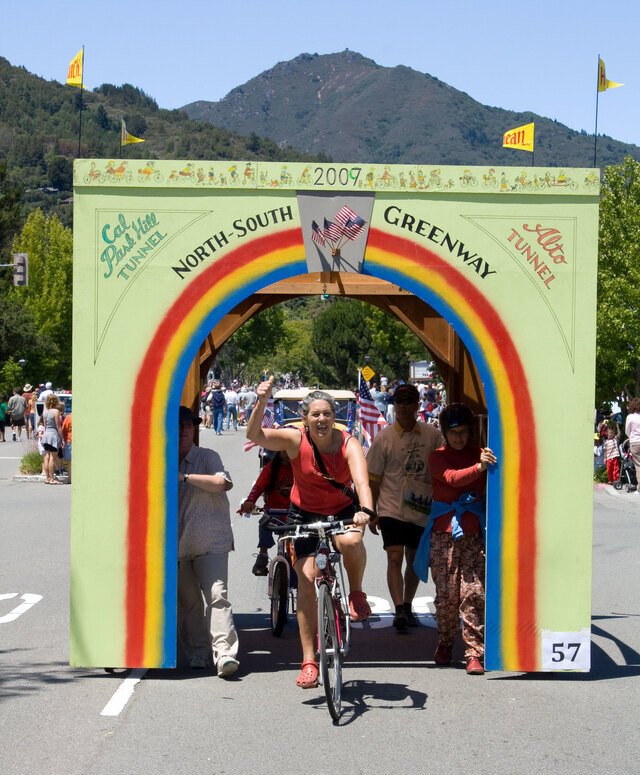
MCBC’s single biggest priority project in Marin is the reopening and rehabilitation of the Alto Tunnel, which would join together nearly 10 miles of off-street multiuse pathway between Sausalito and Terra Linda, with future expansions to Novato via the SMART pathway.
6. If elected to the Assembly, would you support Marin County allocating several million dollars in local funding to conduct environmental review and initial design in order to set the project up to receive large state and federal grants, potentially bringing tens of millions of tax dollars back to the community?
Jackie Elward: Yes. I support Marin County taking the necessary steps to move the Alto Tunnel project forward, including allocating local funding for environmental review and initial design.
Projects like this are how we create a connected, safe, and practical network for everyday travel. Reopening the tunnel would provide a direct, off-street connection between Mill Valley and Corte Madera, giving people a safe alternative to driving for short trips and helping reduce pressure on local roads.
It would also close a major gap in the regional pathway network and connect to the broader SMART corridor, making it easier for people to combine biking, walking, and transit.
Investing locally to position the project for state and federal funding is a smart approach. It allows Marin to compete for larger grants and bring significant resources back to the community, while advancing a project that improves mobility, safety, and climate outcomes.
This is the kind of long-term investment that makes it easier for people to choose biking and walking as part of their daily lives.
Eric Lucan: Yes. There are some key stakeholders and property owners that need to come together and I would be willing to help facilitate. We know that Marin has a great track record in leveraging local funding so advancing the environmental and initial design would be worthwhile if agreement can be reached among the various stakeholders and property interests.
We’re fighting for a more bike-friendly future in Marin. Are you with us? Join Marin County Bicycle Coalition today.